
Round dumpling wrappers are stuffed with ground pork, cabbage, carrot, scallions and kimchi, and steamed. The cooked dumplings are dropped into bowls, hot broth is poured in and the soup is garnished with thinly sliced fried eggs and scallions.

Cook’s notes
It’s mandu-guk in Korean. Mandu is dumpling and guk is soup. These photos have been sitting in my hard hard for four-and-a-half years. Never posted the recipe because I thought it was wrong.
For some twisted reason, I thought that for the dish to be called mandu-guk, the beaten eggs have to be poured into the broth. Like egg drop soup. It turns out that egg isn’t even required in mandu-guk. It’s a garnish and it can be skipped altogether. So, today, I bring you my mandu-guk recipe. My younger daughter, Alex, made the dumplings; I made the soup.
What makes this recipe different from others?
There’s kimchi in the dumpling filling. That addition gives the dumplings a spicier and bolder flavor. And, for that reason, I decided to serve the dumplings in plain chicken broth so that the broth does not overpower the flavor of the dumplings.Were the dumplings cooked in the broth?
No, they were steamed. Mandu can be boiled, steamed or even pan-fried like gyoza; I opted for steaming. That way, there was less chance that the wrappers would be soggy by the time the filling was cooked through. A bamboo steamer was used here. The bamboo cover soaked up the steam and no condensation fell back into the dumplings. With no contact with extra liquid, the dumplings were only exposed to steam. The wrappers were not only firm; the dumplings retained their shape better too.If you prefer to boil your dumplings
If you don’t own a bamboo steamer and the most convenient way to cook the dumplings is to boil them, I recently came across a trick to make sure that the wrappers don’t get soggy before the filling is done. Do you know Ming-Na Wen? Mulan. The speaking voice of Mulan. She was June Woo in The Joy Luck Club before that. Well, she just published a cookbook (I have to buy one) so her Instagram account is peppered with cooking reels (it’s such fun watching her). In one reel, she made wonton noodle soup. Well, she used frozen wontons but that’s not really the point. The point is her technique. She dropped the dumplings into a pot of boiling water and, after the water started boiling again, she added room temperature water. She did it three times. Her reason? Controlling the temperature of the water cooks the meat in the filling without overcooking the wrapping. So, to boil the dumplings, you drop them into boiling water. You don’t cook them directly in the broth. Ming-Na Wen didn’t say that though. I am saying that. Why? To prevent the starch in the wrappers from getting mixed into the broth which will make the broth cloudy and the soup not so attractive.Korean dumpling (mandu) soup
Ingredients
Dumplings
- 2 cups finely sliced white cabbage
- 2½ teaspoons salt divided
- 250 grams ground pork (8.8 oz)
- ⅓ cup chopped cabbage kimchi
- ⅓ cup thinly sliced scallions
- ⅓ cup chopped carrot
- 50 dumpling wrappers
Eggs
- 2 eggs beaten
- 2 pinches salt
- 2 tablespoons cooking oil
Broth and garnish
- 8 cups chicken bone broth
- 8 tablespoons thinly sliced scallions
Instructions
Make the dumplings
- Place the cabbage in a bowl and sprinkle in a teaspoon of salt. Toss well while you prep the carrot, scallions and kimchi.
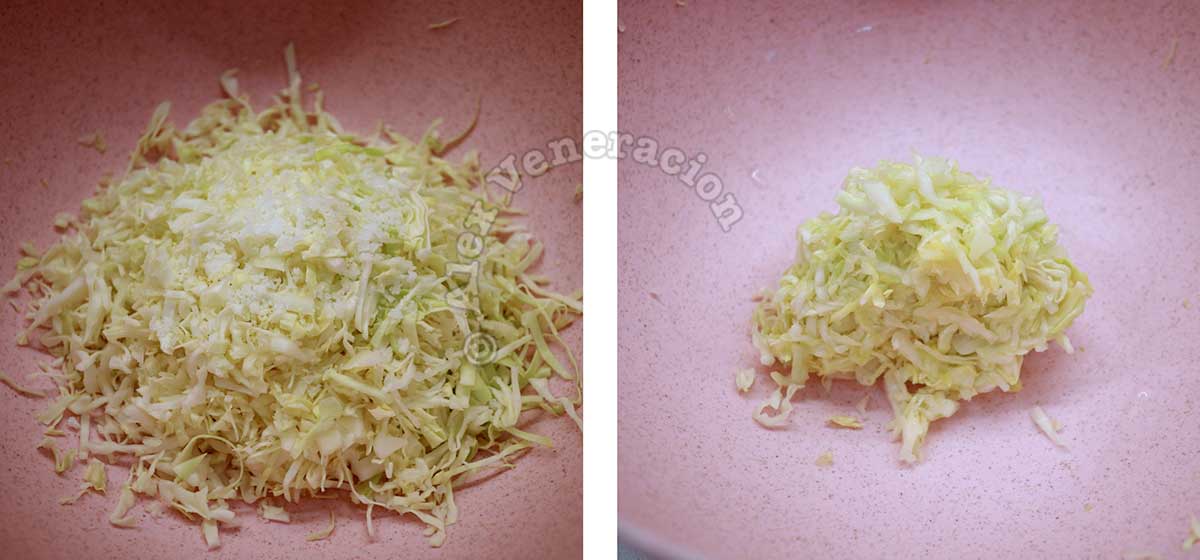
- Squeeze out and discard the water expelled by the cabbage.
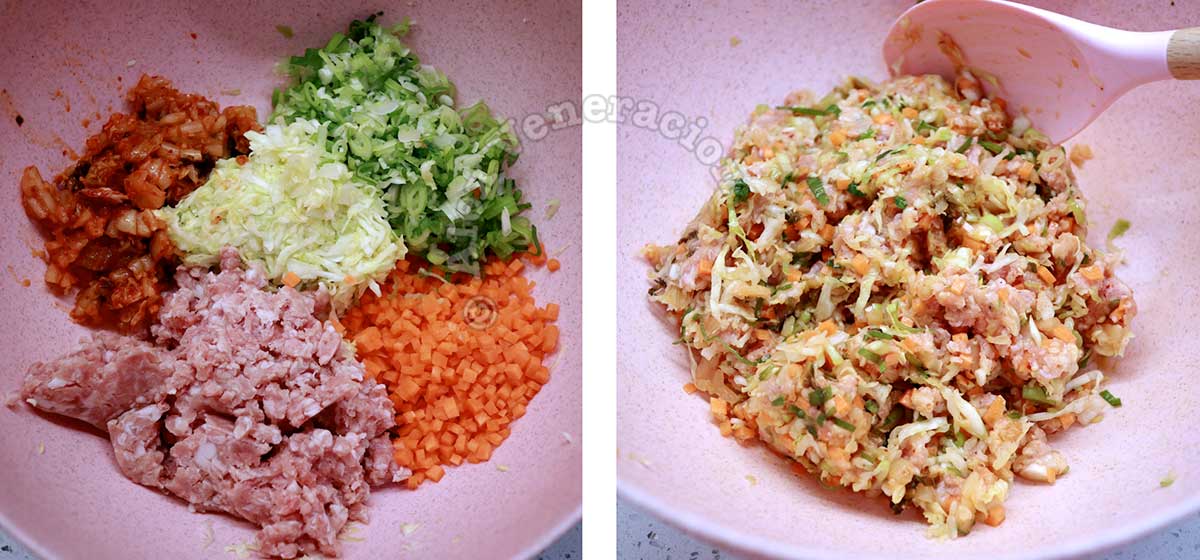
- Add the pork, kimchi, scallions, carrot and the remaining salt to the cabbage. Mix well.
- Take a dumpling wrapper, spread a tablespoon of filling at the center, moisten the edges of the wrapper with water, fold and pinch to seal.
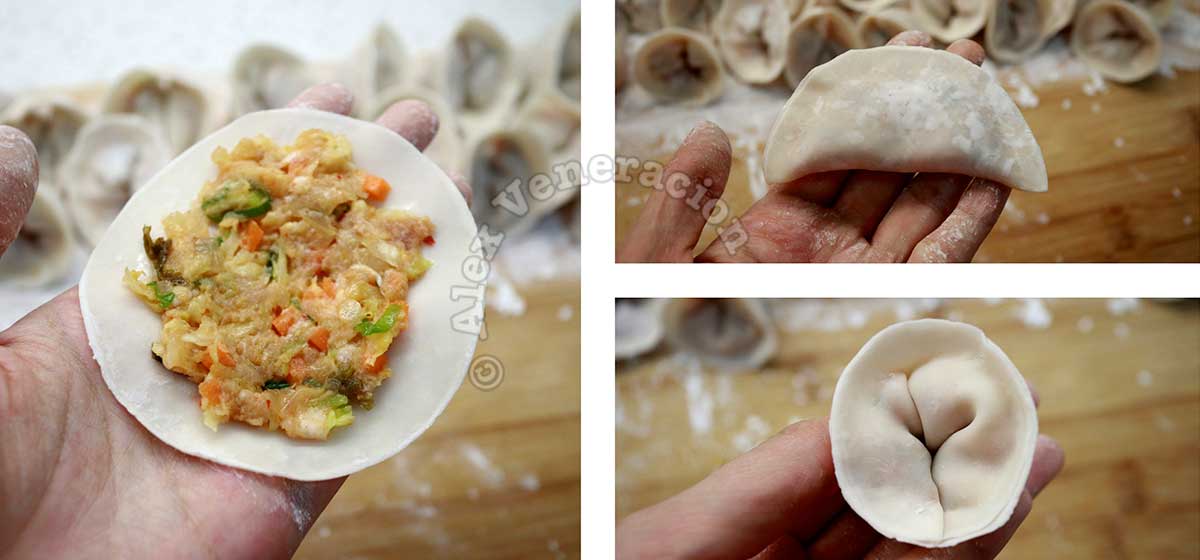
- Moisten the top of one of the pointy ends of the dumpling with water, pull the other pointy end towards it until they overlap then pinch to seal.
- Repeat until all the filling has been used or until you run out of wrappers.
Steam the dumplings
- Heat water in your steamer basin.
- Line the steamer baskets with cheesecloth or non-stick paper poked with holes (commercially available steamer paper come with holes already).

- Arrange the dumplings in the steamer baskets an inch apart and steam over briskly boiling water for twenty minutes.
Cook the eggs
- Stir the salt into the eggs.
- Heat the cooking oil in a large frying pan.
- With the heat set to LOW, pour in the eggs and cook just until set.

- Slide the cooked eggs onto a chopping board.
- Roll the eggs into a log then slice as thinly as you can manage.
Make the soup
- Heat the chicken bone broth in a pot until boiling.
- Divide the dumplings among eight bowls.
- Pour hot broth over the dumplings.
- Garnish with egg strips and scallions.
- Serve immediately.


 Soboro don
